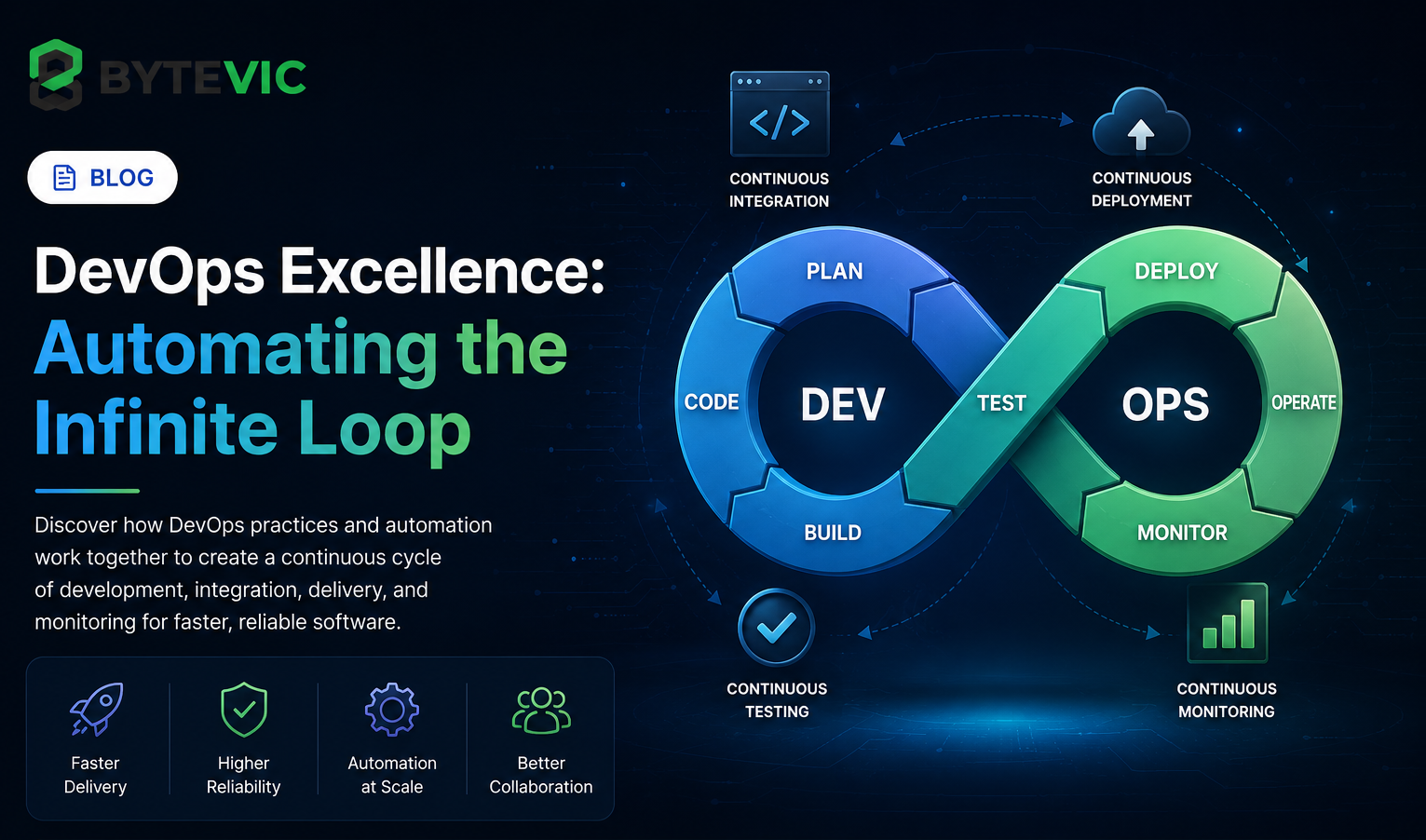
Automation is the heartbeat of modern shipping. DevOps has evolved from basic script automation to Platform Engineering, focusing on building Internal Developer Platforms (IDPs) that allow developers to launch and monitor apps with zero manual configuration.
1. Declarative Infrastructure with Terraform & OpenTofu
Manual cloud setup is the primary cause of configuration drift and security leaks. At ByteVic, we manage all cloud infrastructure (VPCs, databases, clusters, load balancers) as code. Every change is code-reviewed, tested, and automatically applied.
This ensures that dev, staging, and production environments remain completely identical, eliminating the classic developer excuse: "But it worked on my local machine."
ByteVic GitOps Policy:
We configure automated infrastructure deployments using pull request pipelines. Changes to Terraform modules are verified using automated planning tools before merging, reducing cloud deployment errors to zero.
2. GitOps: Keeping Git as the Single Source of Truth
With GitOps, the desired state of your Kubernetes cluster is stored in a Git repository. A reconciliation loop inside the cluster (using ArgoCD) continuously pulls the Git configuration and compares it to the live cluster.
If there is any drift—for example, if an engineer manually edits a cluster configuration—ArgoCD immediately detects the mismatch and auto-heals the cluster back to the Git state.
apiVersion: argoproj.io/v1alpha1
kind: Application
metadata:
  name: bytevic-production-deployment
  namespace: argocd
spec:
  project: default
  source:
    repoURL: 'https://github.com/bytevic-systems/production-infra.git'
    targetRevision: HEAD
    path: kubernetes/prod
  destination:
    server: 'https://kubernetes.default.svc'
    namespace: prod-apps
  syncPolicy:
    automated:
      prune: true
      selfHeal: true // Automatically heals any manual cluster drifts
3. Distributed Tracing and OpenTelemetry
Traditional log searching is slow in microservices. OpenTelemetry allows developers to inject tracing tokens into API requests. As a request travels from the Next.js frontend to Node.js backend, and then to databases or third-party APIs, a single trace map is created.
If a database query takes 5 seconds, the trace will highlight that specific database transaction, saving hours of developer investigation time.
Partner with ByteVic for Cloud Automation
At ByteVic Systems, we help scaleups and enterprise systems build zero-downtime, fully automated deployment environments. Connect with our DevOps specialists to make your deployment lifecycle faster and more secure.